Reviewing Christmas Minimalist Svg for Embroidery
As a designer who has spent countless hours digitizing and stitching out holiday motifs, I have learned that simplicity is often the hardest thing to get right. When I first pulled up the Christmas Minimalist Svg on my screen, my initial reaction was one of cautious optimism. In the world of Illustrations, minimalism can sometimes translate to "empty" or "unfinished" when converted into thread. However, after reviewing the line work and considering its application in real-world machine embroidery design scenarios, I found this asset to be a surprisingly versatile tool for the modern craft business.
The Aesthetic Appeal and First Impressions
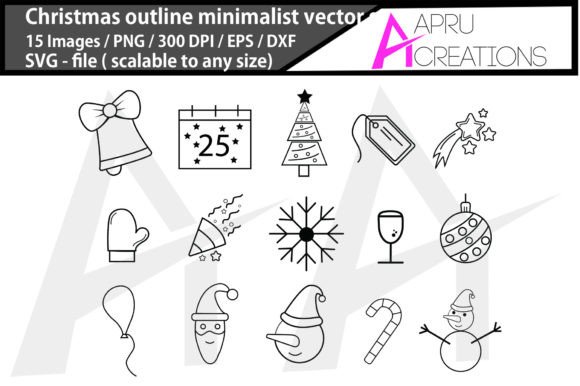
The immediate mood created by this design is calm and contemporary. Unlike traditional holiday motifs that rely on dense fill stitch areas and complex shading, this piece leans into negative space. For an Etsy seller or boutique owner, this is a significant advantage. Modern consumers are increasingly drawn to clean lines that fit seamlessly into minimalist home decor and understated custom apparel. The visual personality of the Christmas Minimalist Svg suggests sophistication rather than kitsch, making it ideal for brands that want to maintain a high-end aesthetic during the holiday season.
From a technical standpoint, the layout appears balanced. The shapes are distinct, which is crucial for maintaining clarity once the needle hits the fabric. In my experience, designs that look crisp on a monitor can become muddy if the stitch density is too high or if the details are too fine for the chosen thread weight. This design seems to respect the limitations of the medium, offering a structure that should translate well into both satin stitch borders and simple running stitch outlines.
Real-World Application: The Holiday Tote Bag Test
To truly evaluate a design, you must imagine it in a finished product. I envisioned using this embroidery file for a custom tote bag design intended as a corporate holiday gift. The scenario was specific: a natural canvas tote with a single, centered motif in deep forest green thread. Because the design is minimal, it does not overwhelm the texture of the canvas. Instead, it complements the fabric texture, allowing the weave of the material to remain part of the visual experience.
If I were producing this as a small shop product, I would also consider its application on sweatshirt embroidery. A crewneck sweatshirt in heather grey or cream provides an excellent backdrop for this type of holiday embroidery. The lack of excessive detail means the design will not pucker the fabric, a common issue with heavier garments when using dense digital assets. Furthermore, because the design is not overly large, it fits comfortably within standard hoop sizes without requiring re-digitizing for scale, assuming the original vector paths are clean.
Versatility Across Product Lines
Beyond totes and sweatshirts, the Christmas Minimalist Svg shows promise for several other categories:
- Baby Embroidery: Soft onesies or burp cloths benefit from lightweight designs. This motif avoids the stiffness that heavy stitching can cause on delicate infant skin.
- Kitchen Textiles: Imagine this stitched onto a linen tea towel or an apron. The minimal nature ensures it looks intentional and stylish, not cluttered.
- Embroidered Patch: For those creating iron-on or sew-on patches, the clear outlines make it easy to create a clean merrowed edge or a simple satin border.
- Nursery Decor: A pillow cover featuring this design can transition from Christmas day to general winter decor, increasing the perceived value and longevity of the handmade product.
Technical Considerations and Potential Pitfalls
While the design is strong, there are areas where caution is necessary. Any experienced designer knows that minimalism leaves no place for errors to hide. If a thread breaks or tension is off, it is immediately visible in simple lines. Therefore, testing on scrap fabric is non-negotiable. You must check your thread colors for contrast. A low-contrast combination, such as white thread on cream fabric, might render the design invisible from a distance, defeating the purpose of the personalized gift.
Additionally, consider the hoop size relative to the design. If you are scaling this down for a cap or a small ornament, ensure that the smallest elements do not become so tiny that they fail to stitch out cleanly. Curved surfaces like caps require careful placement; a design that is too wide may distort when the cap is worn. For dark fabrics, you may need to adjust your underlay stitches or use a topping stabilizer to prevent the fabric pile from obscuring the fine lines of the digital embroidery file.
Stabilizer and Fabric Choice
The choice of stabilizer will make or break this project. For stretchy fabrics like jersey knits used in t-shirts, a cut-away stabilizer is essential to prevent distortion over time. For woven fabrics like cotton or linen, a tear-away may suffice, but only if the stitch density is low. Since this is a minimal design, it likely uses less thread volume, but you must still ensure the fabric is drum-tight in the hoop. Any slack will result in uneven stitching, which is particularly noticeable in long, straight lines or smooth curves.
Commercial Value and Brand Consistency
For commercial embroidery projects, consistency is key. Using a cohesive set of design assets helps build brand recognition. The Christmas Minimalist Svg fits well into a broader collection of seasonal illustrations. It allows craft business owners to create a unified look across different products, from mugs (via sublimation using the same SVG) to embroidered textiles. This cross-platform versatility increases the efficiency of your workflow.
Moreover, the professional appearance of a clean, minimal design enhances customer trust. Buyers often associate sloppy or overly complex embroidery with lower quality. A crisp, well-executed minimal design signals attention to detail. Whether you are creating a printable mockup for your online store or photographing the finished product for social media, this design photographs beautifully. It lacks the visual noise that can distract from the overall composition of a product shot.
Final Designer Notes
Before committing to a full production run, I recommend the following steps:
- Inspect the File: Open the embroidery file in your software. Check for any unnecessary nodes or overlapping paths that could cause machine errors.
- Test Stitch Out: Always stitch a sample on the actual fabric you intend to use. Check for puckering, thread breaks, and color accuracy.
- Verify Licensing: Confirm the license terms. Ensure you are allowed to use the design for commercial purposes if you plan to sell the finished product or use it in marketing materials.
- Mockup Variations: Create black and white mockups to test visibility. Compare how the design looks on light versus dark backgrounds to determine if you need multiple colorways.
In conclusion, the Christmas Minimalist Svg is a thoughtful addition to any designer’s library. It bridges the gap between traditional holiday cheer and modern design sensibilities. By understanding its technical requirements and leveraging its aesthetic strengths, you can create handmade product offerings that stand out in a crowded market. It is not just a graphic; it is a tool for creating meaningful, high-quality personalized gift items that customers will cherish long after the holidays have passed.